Showing posts with label screenwriting tips. Show all posts

Tuesday, December 30, 2014

Prepare Yourself

Making a film look easy, doesn't it? Effortless, even?  You think to yourself, "Oh, I have a story. I just need a camera and some actors."

And then you try to make it.

Your actors aren't real actors, probably your friends, right? And they flake out on your and don't make it on days your shooting... suddenly you realize you have to get the same scene from different angles... how will you ever actually show an explosion? When you finally get to look at your scenes, holy crud monkeys. The sound sucks.

And so it goes.

Am I saying NOT to try? Absolutely not! I think if you have a story inside you, you need to set it free.

If you want to make a film that will really capture attention, mark my words: surround yourself with people smarter than yourself.

You're only as good as your team. And if your team consists of a best friend who runs down the batteries videoing girls on the beach instead of your intense monologue in the Sahara, well, he shouldn't be part of the team.

Start small.

By small, I mean a short film. It's a lot easier to navigate, fail, rebuild and refilm a short film than it is a feature.

Learn to write a script. My GOD PLEASE LEARN HOW TO WRITE A SCRIPT. I can't tell you how many times I've had people give me their works of art and it's not formatted correctly, or slug lines are naked, or it's in the wrong font.  Read Blake Snyder's book SAVE THE CAT and William Akers book: YOU'RE SCREENPLAY SUCKS! for help.  Both of them are gold. Oh if people would read them more.

Find a local film group in your area. Today, the internet makes everything so much easier.  You can find Meetups or local colleges with film schools.

Listen.

LISTEN to your team. I've worked with outstanding people with a wealth of knowledge, but the director wouldn't listen to them. So, what could have been a kick ass movie became a ho hum sleeper.

Movie making is a tedious task. It takes a lot of preparation. And by a lot, I mean months of planning before you even have your first shots. But it's in these months where you iron out all the bumps.  It's in the prep that you get to know your team, too, and how they flow.  Who's the weakest link.  Who is the worker bee.  Who's the one with the connections.  Where the problems are.

If you can troubleshoot BEFORE you shoot, it makes all the difference in the world. Your shoot goes a lot smoother, and before long, you look like you know what you're doing. :)

So please. For your sake, and the sake of your crew and actors: prepare.

Everyone will thank you. And pretty soon, you'll be making the walk down that red carpet.


Saturday, April 5, 2014

From Writing To Directing To Producing

It's been over a year since my last post.  Shame on me. I've been literally swamped.

Without going into every project I've worked on, let me just say tomorrow, a children's television show that has been the desire of my heart to create is FINALLY being filmed!  I am executive producing and head writer of the show. I'm so excited. Tala Hobballah, Michael Haney, co-producers.

On top of that, I have cast some of the best kids in the region to be hosts. One of them, is sweet Noelia, a little one with Down's Syndrome.  I love being able to use the show as proof that kids with special needs can be viable to a production.  She is so excited and we are too!  What a cutie pie. I mean, look at her!

Isn't she precious???

I'll share more about the show once we have it filmed. :)  Let's just say it's pretty awesome!!!! 

I've also written another short film called The Alabaster Phoenix and stars my BFF and biz partner, Buffi Holland has the lead.  So very excited about that too!!!  Logline: A fragile widowed woman grapples with despair and loneliness by discovering her purpose in life.  Lots of locations, and I'm thrilled to possibly be using one of my favorite composers in the universe on this film. Films May 2014. Michael Haney, Dudley Jacobs, producing. 


I'm also producing a short film called PHASE 6. Phase 6 is about governmental population control via the use of flu shots.  It's a sci-fi thriller complete with CGI special effects, so I'm eager to see how this turns out and to work with Jeff Dolan, the director. :)  Starring Keagan Haney, Caleb Shore, Kim Kinsley, and Richard Chilton.  Films June 2014. 

Recently I completed filming a television pilot with the amazing Joe Carroll, writer and director. I earned a producer credit on this one. Can't share the name of the project... YET.  It's a superb concept and I hear it is gaining interest by various sources. As well it should. It's impeccably made and Joe has a keen eye for detail. Shot on the RED camera, the images are crisp, concise, and stunning to watch. 

AMAZING cast.  Photo by Michael Walters

I'm also producing a television show for The Children's Kindness Network called Moozie The Cow.   We have got a great music director, Sara Beck, and Executive Producer, Elandriel Lewis totally has a heart for kiddos.  Research consultants and casting the kiddos  are Colleen Russo, Emily Drossner and Christina Longo. I call them The Vandy Posse since they are all Vanderbilt minds. Ryan Rehnborg is animator. Starring Nina Borum and Caleb Shore.  Moozie the Cow is currently in production. 


So that's my irons in the fire at the moment. I have a few productions lined up to produce... Christopher Siaens "RAIN" is one of those projects. Tala Hobballah has a series she wants me to help her with, and of COURSE I will. Tala is amazing and I cannot say enough things about her and her awesomeness! 

Hopefully I will have a chance to be on here more! I hate such gaps in my entries. I will attempt to do better for you, my ever faithful fans!


Monday, January 14, 2013

Don't Call The Shots... Seriously.

Hello all!

Happy 2013!  Wow have I been busy! Whew!

First of all, let me give you an update. MADAME KOROVA was sucessfully filmed and is in the post production phase.  We all cannot WAIT to see this hit the festival circuit. It turned out to be so much fun to direct.

The talent agency that I own with my completely best friend in the whole wild world, Buffi Holland, has taken off at lightning speed and is flourishing.  You can check out S.T.A.R.S. Talent at HERE if you would like more information. Recently we have booked talent on CATCHING FIRE of yes, THE HUNGER GAMES fame and LAST VEGAS starring Robert Deniro, Kevin Kline, Michael Douglas, and Morgan Freeman.  I'm a proud mama, too... my daughter just got cast in a feature film herself! She starts filming in the fall in Indiana.

Because I've been so busy, I haven't had much chance to write (as you can see from the state of this humble blog!) HOWEVER, I thought I would swing by and offer you a useful screenwriting tip.

When you are writing a screenplay, never, NEVER, NEVER EVER EVER EVER write in or call the shots. I don't mean calling the shots as in deciding what's going on with your character, I mean, writing:

INT. MEDIUM SHOT - VICKI POURS FOOD INTO DOG BOWL

Don't do that.

"Why, ScreenwriterChic? Why should I not do that? How else are folks going to know what I want in this scene?"

Well, to put it bluntly, it ain't your baby anymore. And it's not your job to tell the director what to do.

Once your script has been handed over to a director, it's the director who adds vision to the story and makes it complete.  You have given the framework.  Don't be sad! Your idea may be cool and all, but it's really awesome to see a director come on board with a fresh set of eyes and incorporate their vision with yours. And think about this too... if you put in camera angles and look like a complete noob and an inexperienced dreamer, you will annoy your reader, which is the person you want on your side, believe me! The reader passes on your work of art to the studios.

Now, if you absolutely HAVE to get a certain shot across, there is a way to do it and look professional and NOT step all over the director's toesies.  OR annoy your power wielding reader.

That is in scene description.


EXT. MT. FUJI - DAY

A small speck in the snow, Jessica rummages through her pack.

No food. Disgusted, she throws the pack and SCREAMS.


Okay, did you see what happened here?  A small speck in the snow?  Did you see an aerial shot with that?  And when Jessica couldn't find any food and tosses the bag, you were closer up in your mind's eye, weren't you?

Your scene description frames the picture in the mind of your reader. It's the same as calling your camera angles, but it's a much more appropriate way to do it so you don't have an offended director. Or reader.

And that's what you want, isn't it?


Friday, August 26, 2011

The Screenwriter Think Tank Session of Brilliance


Some of the best advice I was ever given was by Will Akers.

He told me, "You're a good writer. Now start making short films. Learn every aspect. That way, you'll always have work."

I am passing that on to you today, dearest reader.   He was absolutely right!


Now, on to screenwriting stuff.

Last week I held my first ever SCREENWRITER THINK TANK OF BRILLIANCE.

It was truly one of the most outstanding times I have had as a writer. Here's the back story:

I am working on a supernatural thriller script.  I had a vague outline of who and what would go on with the story, but I was stuck. I didn't know how to raise the stakes for our hero. I didn't know what occupation my villian should have.  I have a decent concept for a script, but this was driving me nuts. 

So I called the meeting.

I invited a group of friends.  All were from different backgrounds.  Since my story is about a hero paramedic, I had a paramedic there. I read them the outline from my script, and then for two hours picked their brains.  What a great time!

Folks had AMAZING insight. When all was said and done, I had a full fledged outline, and will get this written probably in a couple of weeks before I start the rewriting process.

The point is, DON'T keep your story to yourself. Pitch it to folks.  See if they'd be interested. I pitched the CONCEPT of this script for about two years to folks.  I would say, "Hey, would you see this movie if this happened?" 

With a group of folks who are from different backgrounds, you will be amazed at some of the ideas that will pop up.  Brilliance!  Even my 14 year old daughter contributed, and I am using her idea.

Now, don't get folks who won't speak the truth. If something doesn't make sense, you want to know BEFORE  you start fleshing it out.  Sometimes people will be 'nice' and not 'honest'.  Honesty is what you want. 'Nice' just wastes your time.

So, if you're ever stuck on writing, hold a meeting and pick brains!  We had a great time and got TONS accomplished!

Wednesday, January 19, 2011

Work For What You Want!!

The movie industry is a monster.

It will eat you up, spit you out, and never look back.  So, to get what you want, you have to fight for it.  The best example I can give you at the moment is this story:

http://www.tennessean.com/article/20110118/WILLIAMSON0702/101180302/Take-a-Bow-Budding-actress-eager-to-work-for-her-ride-to-stardom

This little girl has a once in a chance opportunity and do you think she's relying on anyone else to get her to Tinsel Town?  No! She has totally taken life by the horns and is captain of her own destiny.  (I can say this with my pride in my font because this little girl happens to be my daughter!)

Our family has obstacles, whose doesn't?  But for my daughter, Keagan, the word NO is not an option.  She believes. She fights. She wills.  She overcomes. 

We all need that tenacity in life, no matter if you're a screenwriter, a gaffer, a pediatrician or an electrician! 

Do you have a story?  Write it!  Take criticism constructively!  Make notes, changes and whatever it takes to get your work read! And then... like my little girl....

DON'T GIVE UP!!!!

Friday, December 31, 2010

Make It Tough!

I was going through some past dated blogs by other screenwriters the other day and found this one from Will Akers blog called (like his book) Your Screenplay Sucks!  This is so true. Read on wonderful reader!

Make It Tough For ‘Em!


March 9, 2010

Never GIVE your characters anything.

Make them earn it. Make them fight for EVERYTHING. Every single little thing… if it’s easy for them to get, then the story is boring.

Go through your script and list everything your hero gets. The boy’s phone number. The key to the hotel room. The location of the hidden safe. The cure for cancer. Whatev. Anything they get, look at it, and see if you can make it more difficult for them to get…

Make them earn everything. Make them sweat to get it.

If your hero just gets stuff cause he’s cute, then we don’t feel he deserves it. Just like Robert Redford, when he was auditioning for the lead in THE GRADUATE. The director asked him what it was like not to score with a girl… and Redford said, “What do you mean?” Redford never had to worry about a girl telling him “No.” so he didn’t get the part. Nichols cast a guy who would have to earn Katharine Ross, and we believed his story.

Look at every single event in your story and see if your hero has to struggle to get what you give him (or her!). If it’s easy, you’ve got a weak moment… and you can fix it!

Words of wisdom from Will Akers.  I suggest you heed his advice! :)

Wednesday, November 24, 2010

The Last Word

One of the best things I've learned as a screenwriter is to put the most important word at the END of sentence. 

THAT is where the punch is!

For instance:

I had written a line of dialogue where a naughty merc stated:  "I'd kill my mother for that kind of money."

Rewritten it became:  "For that kind of money, I'd kill my mother."

See? It shocks you... the brain works to put the sentence together and the last word is the final piece of the puzzle. 

One of the best examples I have ever seen was written by Louis L'Amour. (My nod to Will Akers for the quote.) Tell me what YOU think about it.


“I just pointed my rifle at him … and let him have the big one right through the third button on his shirt. If he ever figured to sew that particular button on again he was going to have to scrape it off his backbone.”


Thursday, October 28, 2010

Use Your Gift!

Writing is a craft.

Some say a skill. I think that's a little obtuse. Skill means it can be learned.  Craft means it can be felt and expressed. At least to me that is.

Writing is a gift.

Some of us have it, and some of us... don't.

I received a script yesterday from a very talented and I believe gifted writer. She asked me to peruse it and tell her what I thought.  And I did.

I don't lie. What good am I to you if I don't tell you the truth about your writing?

Luckily, "Heinzy" is a great writer, with fresh ideas.  Her script was easy to read and well thought out. She had a compelling and thought provoking story. And I loved it.

A couple of things were "off" like changing from present to past tenses (writers always have to be on their toes for that), and using the word IS. 

If you see the word IS in your script (not during dialogue of course) then it is probably followed by a verb ending in ING, which makes your story have passive voice.  Agents, producers, readers, etc., HATE passive voice.  However, I personally, overlooked that for the sheer intelligence and brilliant story line she had woven.

So, way to go, Heinzy!  You have a great talent, wonderful ideas, and I can't wait to see your stuff get made!

Now for the rest of you...

What are YOU doing to chase down your dreams?

Saturday, August 14, 2010

Honing Your Craft... and a little Matt Damon

Hello my wonderful fans and readers!

My tribe of munchkins are now in school, so my life MAY become a bit quieter now… (insert insane laughter here).

Anyhoo… since I’m a writer, I figured I would share with you another way to become awesome.  Or at least prove to yourself that you need to take classes OR find another route of prospective employment. (I’m not trying to be harsh, believe me).

Go online to Drew’s Scriptorama. You can google it. From there, download a script. Not a script that says First Draft, because I can assure you it is almost NOTHING like the movie.
Print it out, but don’t read it. Seriously. Don’t.

Then, rent the movie.

As the movie plays, have your laptop or whatever with you.  Pause the movie.

Here’s the fun part:

Write a script for what you saw.

For instance, if you are watching the movie, THE BOURNE ULTIMATUM, you would possibly watch the first two minutes and write what you saw. (I’d watch the whole movie first though, because it is an amazingly fun ride).

So, you would something like write:

EXT. MOSCOW STREET – NIGHT

JASON BOURNE runs to a pharmacy.

And then pick up from there. After you have about a page or two done, pull out the script that you printed. Compare. You will be flabbergasted at how different they are.

EXT. NIGHT – HOUSING PROJECTS – MOSCOW

We are JASON BOURNE and we’re running down an alley.

SUPER: MOSCOW

BLUE LIGHTS -- from the distance -- strobing through the night -- rushing toward us -- POLICE CARS -- three of them - - SIRENS HOWLING as they bear down -- closer -- faster -- until they whip past the alley...

That’s a little big more descriptive than Jason Bourne runs to a pharmacy, isn’t it?

Try it! I started with more laid back films, but as I progressed in my writing and writing hardcore action flicks, this has really come in handy.

You may find that you are missing information that your script NEEDS. You may find that you are giving too much boring information:

SUSIE (blonde, scantily clad, 23) sets down her coffee before dialing her cell phone.

Becomes:

SUSIE (blonde, scantily clad, 23) dials her cell.

It’s amazing what you can learn about the craft and yourself. Plus, you get to see a movie!

Thursday, August 5, 2010

In Memory Of Blake Snyder

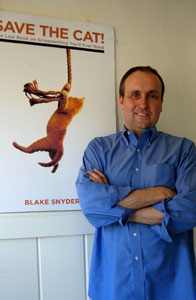
If you don't know who Blake Snyder is, you're probably not serious about screenwriting. His Save The Cat! books have been screenwriting bibles to folk.

I've never met Blake. I've never spoken to him. Never spotted him across a room and was too shy to speak to him. Yet I'm a product of him.

You see, my mentor, Will Akers, met Blake one day and the two formed a friendship. Out of that friendship, a book was created, but not only that, a bond between the two. Blake cheered Will on and taught him a lot of great stuff that Will, in turn, has passed on to me... and countless classes before me.

It's been one year since Blake's passing.  It's strange. I remember the tweets, the Facebook posts, all saying Rest In Peace and what not. I remember reading Tracey Jackson's tear jerker of a blog as she told why she would miss him so.

As a tribute to Blake Snyder, I have copied the following from Will's blog, Your Screenplay Sucks! It can be found at http://yourscreenplaysucks.wordpress.com/. If you'd like a great blog to follow, I highly recommend it.

Anyway, here's hearing from William M. Akers:

Blake Snyder

August 4, 2010

I miss him.

It has been a year. I’m sitting here in my office sweating because I have to turn on the air conditioning and because I worry I won’t write the right thing about Blake.

What a prince among men. That cliche certainly fits.

He is 100% responsible for the existence of this blog because he is 100% responsible for the existence of my book. When I got the idea for a book on screenwriting, he encouraged me and said he’d tell his publisher. They agreed to publish it and here we are.

Blake was long on encouragement.

I miss that a lot.

Anyway, I miss him. I miss his advice. I miss his voice. I miss his loyalty and his kind nature. I miss his smile and I desperately miss his friendship.

Boy, do I miss that.


We Miss You, Blake.

Friday, July 30, 2010

Checklist of Champions

I was recently given a checklist from Will Akers. This checklist was written by Jeanette Winterson and is very good for aspiring screenwriters... and practiced produced screenwriters, too. Like Will!

I wanted to share it with you because it's just so good.

1. Do your work. Discipline allows creative freedom. No discipline equals no freedom.

2. Never stop when you're stuck. You may not be able to solve the problem, but turn aside and write something else. Don't stop altogether.

3. Love what you do.

4. Be honest with yourself. If you're not good, accept it. If the work you're doing is no good, accept it.

5. Don't hold on to poor work. If it was bad when it went in the drawer, it will be just as bad when it comes out.

6. Take no notice of anyone you don't respect.

7. Take no notice of anyone with a gender agenda. A lot of men still think that women lack imagination of the fiery kind.

8. Be ambitious for the work and not the reward.

9. Trust your creativity.

10. Enjoy this work!

Hi again, it's Screenwriter Chic.  I would like to touch base on a few things.

You must write everyday. Not as a chore, but as a work out. An Olympic champion can't just skip a few work outs and then expect to win the gold. They have to stay finely tuned. Same for the writer.

If you're stuck, and I've been there before... I suggest the following. Take a sheet of paper and write the characters name (or type it, whatever) and make a list of the first thing that comes to mind. It's very freeing.

Example:
Bonnie Spailsenberg
She could:
learn to shoot
be abducted by aliens
have a baby
go back to school
sell bottled water

It doesn't matter how silly or weird it becomes, because only you will see it. And it can spark some truly wonderful ideas. Everyone say thank you to John Truby for this exercise.

You MUST love what you do. If you don't, and you consider this work, well, you'll probably be miserable.

If you can't seem to "get it" and you're work stinks, like Ms. Winterson said, maybe you should walk away. It's not that you don't have talent. It could be that your talent is elsewhere, like directing. Writing is hard and not everyone can do it.

Seriously, don't hold on to poor work. I've gutted scripts and reworked them only to gut them again. If I've written a scene that I love, but it doesn't push the movie forward, it gets cut. Actually, I put it in a file on my computer because I may actually use that scene, but for a different script. That's the fun part of my job.

The taking no notice of anyone you don't respect is HUGE. Say you have Daddy issues. All your life you have just wanted to please him. You write a touching story about a dog who saves the world by flying to space on a giant hot dog and in the process discovers who his father is. By the end of the movie Papa Dog has accepted Astro Dog and told him he's proud of him. Fade Out.  And what do you do? You let Daddy read it. He hates is. No guns, no sex, no swearing, you name it. And you're crushed. You throw the next Pixar gem in the trash because of what Daddy says. Unless he's a producer, director, or screenwriter, don't do that! He has no idea what it's like to 1. write a screenplay and 2. get it made. Surround yourself with people you can trust and respect.  I personally, have my script read and reread by folks. My 'club' consists of Jill, who is a smart screenwriter with great insight. Kristy, who will read it from an 'audience' point of view and show me where she gets confused. If she gets confused, a reader will get confused. I can't have that.   Then Ann, who is my editing queen. She locates all the grammar mistakes that spell check missed. Again, she tells me if my scenes are confusing. Once it looks okay to me, I'll hand it over to Will. From there, it comes back, bathed in red ink and I start the rewrite. The point is, all of these people I respect highly, and all help me form this work into something that could possibly wind up on the coveting silver screen.  And none of them kiss my butt. If they don't like something, they tell me.

Take no notice of anyone you don't repect. You can love Daddy and respect him as Daddy, but he doesn't determine if your script is made or not. Shrug and walk away.

The gender agenda is huge. I recently set a query to an agent. He wrote back and said, "Not interested... women don't write like that."  I can't wait for my stuff to get made and I'm going to track him down one day. Poo on narrow minded folk. Break molds!

Being ambitious for the work and not the reward, trusting your creativity and enjoying it all is totally up to you. I write because I love it. I come up with stories and get them out. It's a fun puzzle piecing for me.

Anyhow, dear fans, I hope this helps you.

Good luck!

Saturday, July 17, 2010

Drama is Action

Thanks to you, my wonderful readers, for your patience as I grieved (and still do so) the passing of my sister, Tracey. If I know Tracey at all, she’d be severely upset with me for not posting another blog entry sooner, and about screenwriting. SO! Here you go!


I read in a fantabulous book called “Essentials of Screenwriting” by Richard Walter that “drama is action.”

“Well, duh!” you say. But let me ask you. How many times have you seen a bunch of characters sitting around talking about nothing that advances your movie plot? It’s the lull in the movie where folks go to the bathroom and get more popcorn. Or worse.


If you have a script with that kind of scene in it, cut it out NOW. If you’re going to have a scene with people gabbing, it better darn well advance your plot. You can’t be precious about your script. By that I mean, if you write a kickin’ dialogue that you love; it really doesn’t help your plot but you still keep it in there. Why? Because you like it.

It’s not what you like that will sell your screenplay.

Your plot must always be moving, always be pushing ahead. By doing so, your reader will gladly follow and that is exactly what you want.

Again from the book mentioned above, the author states (and quite accurately):

“Screenwriters are required, therefore, to determine for each scene the action that most effectively advances the story and expands the characters and also to craft the ideal setting for that action.”

As a screenwriter, we can’t hope the reader will ‘understand’ what we’re hoping to convey. We must show them. Readers don’t have time to try and decipher. That’s what the grand round circular file is for, and I really don’t think that was the action, the drama, you wanted for your script, now was it?

Tuesday, June 29, 2010

Reversal Rollercoaster Ride!

Ever seen a movie and thought: This is SOOOOOOOOOOO mundane? You can tell where every scene heads and you can predict the outcome? Can we say BORING?!?!? I hate movies like that! UGH!


The screenwriter probably is very good at what he does. The problem is REVERSAL.

A reversal is that part of the scene where you go, “Oh my GOD! I never saw that coming!”


A great reversal is in THE DEPARTED. Leonardo Di Caprio’s character has worked and worked on nailing the bad guy, Matt Damon. He finally has him in his control and they’re on an elevator. When the elevator door opens, BAM! Leo’s shot in the head! I don’t know about you, but I NEVER could have predicted that! And I love the movie for that. It completely changed the tone of the movie! And, if that wasn’t enough…here comes another reversal…Matt Damon’s friend is the one that saved him. Matt thanks him and BAM! He shoots his friend! If you haven’t seen the movie, it’s highly recommended. By little ol’ me.

Reversals add a depth to your script. It shows you aren’t contained in a pretty little box and you actually think outside it. You have innovative, new, and unique ideas.

Have you ever seen Shutter Island? Another FANTASTIC example of reversal…all the way to the very last scene. Amazing! And one of my favorite movies of all time, now.


Look at it this way: the more twists on a rollercoaster, the better the ride, right? Same thing here. Your audience, your reader, has committed to spend time on your “ride”. Give them the twists, turns, and drops that make a ride so great! Make it worth their while! Because…

…if the reader loves the ride, your chances are much better for your script to find its way into the hands who can hook up with your vision, see the movie posters, the taglines, the merchandise, and hot dog! You’re off and running!

Reversals. Your script needs them. It’s what separates a good script from a great one.

Monday, June 21, 2010

I Got A Pat On The Back!


As you all should know, Will Akers, author of Your Screenplay Sucks! 100 Ways To Make It Great, is my mentor. I continue to help him on projects, and he in turn, helps me on mine.

Recently, I outlined a new screenplay I'm working on. I believe it's a fresh idea, but I needed some help on opening it. I had a lot of fade ins and outs at the beginning and consulted him on how to write it.

"Email me your pages," he said.

I did. 

The next day, this showed up on his blog:
(Reprinted with permission from Will)

a little research is good…


June 19, 2010

Be specific, but be specific in the right way.

A student of mine, who is a very good writer… probably because she is a very good writer, not because she’s a student of mine, wrote this…

***
INT. MERCY HOSPITAL EMERGENCY ROOM – NIGHT

Meg completes her run ticket.

***
Do you know what a “run ticket” is? I do not. Do you think Meg knows what it is? I bet she does. This is a marvelous example of knowing what you’re writing about… but not letting the research get in the way. We read that sentence, have no idea what “run ticket” is, but we also get the sense, mostly via osmosis, that it is the CORRECT thing, and that it fits and is meet and right and good and just and all that stuff.

Good on ya, Marti!

Conversely, I recently critiqued a screenplay… and I have no idea who wrote it, or what it was about… One of the marvelous services I provide as screenplay critic is a leaky brain, one from which knowledge and memory of your story trickles with the setting sun. I read. I crit. I forget. So, if you want me to crit again, it’s like I am reading for the first time. I’m like a bee. I have a three day memory.

Anyway, this writer was writing some sort of WALL STREET type business script. The writer obviously was not a Wall Street business type, because the scene description, instead of some perfectly perfect description of a Wall Street woman hard at work, would say “Alice works on some papers.” That shouted for Lassie like little Timmy in the well, “Get me outta here!”

Every time the writer would take us to the office, there would be bland references to the work being done. “They work hard.” “Everyone is busy.” Stuff like that.

Not: “Meg completes her run ticket.”

THAT is a fantastic sentence, and it TOTALLY makes me buy that the writer knows what she’s writing about, and it calmed me down and urged me forward, secure in the knowledge that I was in the hands of Someone Who Knows, instead of Someone Who Hopes I Won’t Notice.

 
**Wow! Thanks for the pat on the back, Will! Considering it comes from one of the most objective voices in screenplay critquing, and from a seasoned actual screenwriter with movies that have been made, I'm truly honored.  ~Marti AKA ScreenwriterChic**
 
You can order Will's book (HIGHLY recommended and such an easy read) at http://www.yourscreenplaysucks.com/html/order_my_useful_book.html
 
And I'm sure it's on Amazon as well.
 

Thursday, June 10, 2010

PROOFREAD!!!

You know what reeks of amateurs? Work riddled with type-o's.
I've been cleaning out old emails and I found one that I had written to my staff. (Yes, I have a staff, no it's not that kind).

I wanted to share it with you, since I had to eat humble pie and admit I actually sent an email with an error in it. Horrible. And, before you ask, yes, I DID have to send out the email. Why? To squelch rumors. Names have been changed to protect the innocent.

Read on, dear fan! And see how important it is to proofread! And yes, this IS an actual email I sent out.


Sent: Wednesday, October 10, 2007 9:44 AM
To: All Staff

Subject: amendment

Okay Girls,

This is an amendment to my email I sent out earlier.

I want to make it very clear that I did have a type-o and that Patti had mice rice on her SHELF. NOT her SELF.

I hope this corrects any problems that could have been misconstrued.

So, to make it clear: Patti is NOT infested with MICE on her person. It's her shelf that they apparently like to hang out on. NOT Patti.

Patti is not a friend to rodents, as my hedgehog can attest. Patti does not have mice on her or anywhere in her clothing. Patti, as a person, is completely 100% mice free.

Therefore, Patti will NOT be exterminated, nor will we call an exterminator to check her out. I hope this clears everything up.

Should you have any questions about the matter, feel free to ask me.

Signed,

Your Loving Boss

 
See what I mean? How embarassing! PROOFREAD!
 

Monday, June 7, 2010

Update On FIRST DATE & life in general. It's Good.

Swinging by to let you, my faithful followers, that I am doing well!

As you know, I’m shooting another short film that I’ve written, this time NOT in a twenty four hour period on severe lack of sleep. I think I’ve determined that I’m a time Nazi. I finished three days of shooting in ONE day, which gives me TONS of room for reshoots if I don’t like what I see in the editing suite.

Yes, once again, my kiddos are my guinea pigs, but they are doing quite nicely and giving authentic performances. Plus, they are having fun. Isn’t that what it’s all about? They enjoy helping me on my projects. I enjoy the family time. For me, it’s a win win situation. I’ll keep you updated!

On another note, during my one day of shooting, I took a four hour break to attend the Nashville Screenwriter’s Conference (thanks to my friend Jill and her phone call reminding me)! I am SO glad that I did!

I heard some great words of wisdom from Jeff Lowell (Hotel for Dogs, show runner for Spin City): “In television, you should write so you can be doing the dishes and HEAR everything and know EXACTLY what’s going on. In movies, you should be able to be on a plane, not purchase the earphones and SEE it and know exactly what’s going on.”

That is SO true! I’ve never thought of it that way, but now, I’ll never forget.

The highlight for me, however, was getting to finally meet Derek Haas. Remember him? He wrote WANTED, THE FAST AND THE FURIOUS 2, 3:10 TO YUMA, to name a few. (He also wrote CATCH THAT KID which my youngest loves). For those of you who don’t know the story, my screenwriting class had a conference call with him last fall. From there, I found him on Facebook and we became friends. We banter back and forth and I teased him about coming to Nashville and told him that I’d bring him a cupcake. His response was that it had to be cinnamon, his favorite spice. That was six months ago.

So there I am, sitting with Jill, watching the end of a panel. Everyone leaves and there is Derek in the back of the room chatting with someone. He heads to the main chair and I call to him, introduce myself which receives a hearty reaction and I offer him the cupcakes. He gleefully takes them and is floored to discover that they’re cinnamon. I beam with pride at my accomplishment. I’ve made his day. Everyone around me (other than Jill) scoffs, believing this to be a putrid attempt at bribery.

I don’t care.

I’ve met someone whose writing I esteem highly, whom I consider a "real" friend now. We’ll continue to banter on Facebook.

And, when all is said and done, whose name do YOU think he remembered from the conference?
Marti, Derek, & Jill

Thursday, May 27, 2010

Memorable Characters Take Memorable Writing

To create memorable characters, I’d like to make a suggestion.

Keep a journal of overheard dialogue. Gasp! ScreenwriterChic, are you telling me to eavesdrop? Yep! I’m not saying stalk anyone, but you can grasp different rhythms, different accents when you eavesdrop. No one wants to hear characters that all sound like you. Each character must have a distinct voice. Each character must be different.

One of my favorite lines from a movie is, “Yeah. You blend.” It’s from MY COUSIN VINNY, written by Dale Launer (whom I have had the privilege of speaking with… but about RUTHLESS PEOPLE). I love this line so much that I posted it as a status on Facebook the other day.

You’d be surprised the reception it had! For three pages, people posted their favorite lines from the movie. Which tells me it was great writing.

When you make your character, each one MUST have their own voice. Lisa didn’t sound a THING like Vinny (of course she was female!) They both had thick New York accents, but her rhythm, her speech pattern was different. Her ideas were different. Her focus was different, which crafted her character. By the time Marisa Tomei got a hold of the part, it was just finishing touches that were needed.

Each character had a distinct voice. You could tell each character was DRAMATICALLY different.

“Are you mockin’ me in that outfit?”

“Mrs. Reilly. And only Mrs. Reilly!”

“A doe eyed little de-uh!”

“I don’t know! I’m a fast cook, I guess!”

“Same make and model tire!”

“Aidin’ and abettin’!”

“Maybe the laws of physics cease to exist on your stove! Were these magic grits?”

“Ladies and gentlemen of the j-j-j-j-j-j-j-j-j-j-j-jury.”

“Seb’n bushes!”

“The two what?”
“What?”
“Did you say, Utes?”
Oh, excuse me, Your Honor. The two youths.”

Can you see these characters? The diversity adds so much depth to the story, a reality to it, if you will, and every scene becomes memorable. So much so that Marisa Tomei walked away with an Oscar for Best Supporting Actress.


Make your characters memorable. They will make or break your script, and ultimately, your movie.

Tuesday, May 18, 2010

Confusion = Bad

When you write a script, you are writing it for the READER. The reader is not the producer or the director, your mom or your dad. The reader is the one who holds the power. Why? Because they give coverage on your script with the ‘thumbs up’ or ‘thumbs down’ to move it along TO the producer or director.

The READER.

Yes, it’s an actual job. It’s thankless and overwhelming and time consuming. I know this will be a shocker, but they WILL toss your script into the doomed circular file if:

1.) they get confused
2.) they hate your script or
3.) your script isn’t properly formatted

Don’t blame me, I don’t make the rules! I’m going to break this down in the next few blogs for you. So, let’s take Number 1.

How can a reader get confused?

Besides a poorly constructed script, I’m going to focus on the most recent and one of the most pertinent errors to cause confusion in a script: NAMES.

I recently read a man’s script which was pretty good, however, he had three characters that all started with the same first letter. To make matters worse, he had a dialogue with all three of them. I was completely lost and if I wasn’t critiquing it for the guy the script would have been deep sixed. It was extremely hard to follow.

Jesse, Jessup, and Justice.

Sweet Lord, people. Don’t give your characters the same first letter. You have an entire alphabet at your disposal. Please use it. There are baby names books that can help if you get stuck!

Another note: try to change the syllables of the names.

Your goal is to make it as easy as possible for the reader to intake the information, keep up as they speed read, and give you a good mark. Don’t have Bob and Tom. Have Bobby and Tom. Or Bob and Tommy. Bonnie and Annie should become Bonnie and Ann. Make it easy.

Don’t have rhyming characters. Kelly and Shelly. Mindy and Cindy. Craig and Greg.

Let me try to break it down a bit better for you.

Imagine an office. Desk. Fluorescent lights. Office supplies. Starbucks.

Now imagine the desk with stacks upon stacks of 110-115 page scripts. You can’t see the office supplies. You can’t see the desk. There are scripts in stacks on the floor. Two things can be made out in this room. The chair and the rather large wastebasket. And your script is in the stack.

The reader picks up a script. Not one with an embellished covering or title page. Those reek of amateurism and are immediately tossed into the dream eating can. She looks at the title page. If it looks good, she flips it open.

A reader will know by page 10 whether he or she will continue. It’s not that he or she doesn’t like you. It’s not that he or she doesn’t like your idea. It’s the fact that he or she has to understand what you’re trying to say. What takes us an hour or so to read will take them thirty minutes. They’re speed reading demons!

Why wouldn’t you want to make it easy for them? If you make it easy for them, you make it easy for them to give you great coverage and move your script along.

“Now, hold on a minute!” you say. “I’ve seen movies where there are rhyming names, and people start with the same first letter!”

Yes, that’s true. Most of those movies were written by the producers or already had money behind them.

Let’s take Twilight, New Moon, and Eclipse for example.
Two of the characters names are Jacob and Jasper. I have heard countless people get Jacob and Jasper confused. Even more so with the folks who read the book. Did it hinder the success of the movies? Nope! But Stephenie Meyer was approached to make her book into a movie and had a screenwriter adapt her work. This wasn’t a script she sent in.

You can do what you want. Take my advice or leave it, it’s up to you. I’m just trying to give you some insight to offer you the best possible chance to get your work up on that coveted silver screen.

Why make it harder for the reader?

Why make it harder for yourself?

Friday, May 14, 2010

There's A Method To My Madness!

HOW DO YOU DO IT?

There’s nothing more exhilarating than typing FADE OUT, sitting back, and letting out that sigh that says, “I’m done with this one!” It’s a great feeling of accomplishment. I pat myself on the back for ten seconds and then print it out.

“Oh! You shop it around?” you ask.

NO WAY!

I’m going to share with you my method of making a kick butt screenplay.

First, write the darn thing! You’re not a writer if all you do is complain that someone stole your idea and you’ve not written a lick about it. Write it!

Then, find yourself a group of people who will not kiss your butt, yet are supportive in your endeavor.

I happen to be surrounded by people who love my ideas and I’m constantly bouncing ideas off of them. When their eyes light up and they exclaim, “I would SO go see that!” I start making rough outlines.

By rough outline, I mean I take a beat sheet and give my idea a small amount of framing. Then, I start fleshing it out a bit. I ask people what outcomes would be better, what twists would be cool… the point is, I get a free focus group on what people want to see. I write the script. I let people read the script.

“What confuses you about the plot?” I’ll ask. “Can you see everything I’ve written?” If the answer is no, I tackle that section. If they are confused, I know I need to work on setting things up earlier.

I enjoy this part of the writing because this is where I really get to “meet” my characters.


Melissa Scrivner, a writer on the hit series CSI: Miami stated in an earlier interview, “I feel like on the first draft, the characters don’t speak to you until you go through the pain of rewrites. Then they become real to you.”

I couldn’t agree more.

I’ve recently completed a script. I’ve been working on it close to a year. I don’t even know how many rewrites I’ve already done on it. My main character, in the first draft, was calculating, cold, and could kick some serious tail. Action packed, yes, but there was nothing human about her. At all. It was through the rewrites that I found out why she did what she did and why she was who she was. She revealed her humanity to me, not me forcing humanity on her. The character became a breathing person on my pages. Strange to say, but it’s true. And right now, on my pages, she’s in her truest form. A director will see her differently. A producer will see her differently. The actress will see the character differently. And I’ll have to let her go and be who they want her to be. I'm okay with that.


I wrote this for me.

That doesn’t mean I throw what people tell me out the window. The people I have who read my stuff critique it. They know what to look for. They show me grammatical errors and mistakes. I’m glad to have them around! If they say that something confuses them, then it will confuse the READER and that’s who I need to be on my side!

I do not use flowery description. That screams you’re an amateur if you do. Precise. Short. Words. Bingo.

I have to say, I’m a blessed woman to have the people around me that I do. They read my drafts, lines of dialogue, scene descriptions… and willingly! What a great group of people I know! And the best part, is that when I say, “Gut it!” or “Bathe it in blood!” (Meaning red ink, of course!) They do. They know my feelings aren’t going to be hurt. I want to know what is wrong. I don’t want to send out something that is not professional. If you don’t have that kind of support and you want critiques, feel free to shoot me an email. If I have time, I’ll do it.

Just don’t act like Raul. (check him out on a few posts past).

Different people have different methods. Don't be afraid to try! What method works best for you?

Monday, May 10, 2010

Just Slug Away!

Let’s talk slug lines.

For beginners that read this blog, a slug line is that one scene description in one line:

INT. OFFICE – DAY

That’s a slug line. But it’s not terribly descriptive, is it? You want to get as much information across to your reader has humanly possible in that one line. Make the slug line work for you!

INT. SCREENWRITERCHIC’S EMPTY OFFICE – DAY

Now, you know four things:
1. The scene takes place in an office
2. The scene takes place in MY office
3. My office is empty.
4. It’s daytime.

That gives out a lot of information. Which is a great thing! I read one guy’s script that said:

EXT. OPEN RANGE – DAY

Well, what does that mean? Is it a shooting range? A cattle range? A range in Kansas is WAY different than a range in Colorado. Help the reader out!

EXT. COLORADO CATTLE RANGE – DAY

Gives a better description of where you are, doesn’t it?

Slug lines are your friend. They’ll work for you if you let them. Which brings me to NAKED slug lines. Ever heard of those?

Naked slug lines are slug lines that have no description under them at all.

EXT. COLORADO CATTLE RANGE – DAY

                            JOHN
              Hand me that there shovel, Curly.


What? There’s a shovel? What is going on? You don’t want to confuse the reader! So… always have your slug line follow with some sort of description. It can even be two words.

INT. MUSTY BANK – DAY

Busy. Crowded.

Annabelle prepares the deposit.

So, now you know that you’re in an old musty bank (because new banks aren’t musty) and it’s a busy day in there. The slug line has set the stage for you to then tell us what Annabelle is doing. You get a better feel of her surroundings and is the framework of that scene.

You’ve used the slug line to work for you AND you’ve probably saved two or three lines of writing thanks to your precise writing skills…two or three lines that can now be used on your witty dialogue!

Great job, Slugger!